

What is a non-ductile concrete building?
A non-ductile concrete building is a reinforced concrete structure that is constructed without adequate detailing to ensure ductile behavior during an earthquake. The word “ductile” means that something can deform without breaking, which is the desired behavior of buildings in seismic zones as it allows for seismic movement without causing brittle failures in the structural elements.
The 1976 Uniform Building Code, which was adopted by jurisdictions in the late 1970s and 1980s, was the first building code to require reinforced concrete structures to be designed and detailed for ductility. Due to the lack of these requirements before 1976, many concrete structures built prior to the 1980s—and even sometimes up to the late 90s—are not detailed to ensure ductile behavior. These buildings are called “non-ductile concrete,” or “NDC” buildings.
Why are non-ductile concrete buildings problematic?
If a building lacks ductility, brittle failures are more likely to occur in structural elements during an earthquake. Non-ductile buildings are therefore at higher risk of structural damage and collapse from a moderate to severe seismic event.
What is San Francisco’s Concrete Building Screening Program?
San Francisco Ordinance No. 70-25 (File No. 250211) amends the San Francisco Existing Building Code to assess the inventory of vulnerable Rigid-Wall-Flexible-Diaphragm (RWFD) and certain Concrete Buildings (CB) and to adopt voluntary seismic retrofit standards for such buildings. The Ordinance does not require mandatory retrofits.
The definition of RWFD and CBs in the ordinance:
-
-
- Rigid-Wall-Flexible-Diaphragm (“RWFD” aka “tilt-up”) Building: A one-story building or building portion, not counting mezzanines, with a lateral force-resisting system that would be classified by the latest edition of ASCE 41 as either PC1, RM1, or C2a with flexible roof diaphragm. (E.g. large warehouse building with concrete walls and a wood roof.)
- Concrete Building (“CB”): A building where vertical elements of concrete construction, such as walls or columns, support gravity load from floors or roofs; and/or vertical elements of concrete construction are part of the lateral force-resisting system.
-
Voluntary retrofit standards are included for Concrete Buildings as Chapter A6 in the Ordinance. It is the intent that buildings that are voluntarily retrofitted pursuant to Appendix A, Chapter A2 for Rigid-Wall-Flexible-Diaphragm buildings or Chapter A6 for Concrete Buildings will be exempt from any local mandatory seismic retrofit requirements for 20 years after the effective date of the ordinance.
What do I do if I have a concrete building in San Francisco?
Many building owners were contacted by the City in late 2025 with instructions on how to meet the requirements in the Ordinance. All buildings that meet the criteria of the Ordinance should be assessed, even if the owner is not notified by the City.
Action items for those who receive a notice from the City or who suspect they own a concrete building that is addressed by the ordinance:
-
-
- Review the information on SFDBI’s website.
- Fill out the online form on SFDBI’s website.
- Property owners may fill out basic building information, but a California-licensed design professional is required to submit the structural information.
- Submit your screening form by June 9, 2027.
-
Does San Francisco’s concrete ordinance require retrofits?
No, Ordinance 70-25 does not require any building to be retrofitted. It only requires a screening form to be filed for certain concrete buildings. It does, however, include voluntary retrofit standards. The intent is that buildings that are voluntarily retrofitted in accordance with the Ordinance will be exempt from any local mandatory seismic retrofit requirements that may be enacted for 20 years after the effective date of the ordinance.
What are some strategies to retrofit non-ductile concrete buildings?
Based on knowledge of old building code provisions and lessons learned from past quakes, the pitfalls of non-ductile concrete buildings are well known and can therefore be remedied.
Retrofits typically involve increasing the stiffness and strength of buildings to ensure that there are structural elements that can transfer and resist seismic forces and prevent the degree of movement that would damage or collapse the original concrete structure. Some common strategies to retrofit non-ductile concrete buildings include installing diagonal steel braces between floors, adding reinforced concrete walls (freestanding or installed against existing concrete walls), strengthening concrete elements with fiber-reinforced polymer (FRP), and improving connections between structural elements.
Another way that non-ductile buildings can be retrofitted is to reduce the effect of seismic forces on the building. This can be done by isolating the building from the earth below it—called base isolation—or by installing structural elements called dampers that function like shock absorbers. These retrofit options require extensive structural analysis and specialized products but can provide solutions that are less invasive to an existing building.
To learn more, contact ZFA at [email protected].
Resources
-
- The Structural Engineers Association of Northern California (SEAONC) published a summary of seismically vulnerable existing buildings that includes additional information, photos, and examples of NDC and RWFD buildings.
- The Department of Building Inspection published an FAQ sheet to answer common questions about the ordinance.
Need assistance with an SF NDC screening form? Contact ZFA at [email protected]
NDC ORDINANCES IN OTHER CALIFORNIA CITIES:
ZFA’s NDC Experience
While non-ductile retrofit strategies can be similar for different buildings, each building is unique. Similarly, the goals and priorities of each building owner are unique. Therefore, the approach to a retrofit begins with listening and understanding owner concerns, priorities, and hurdles as well as gaining a thorough understanding of the structural system and deficiencies to be remedied. Additionally, value can often be added to a project by incorporating retrofit designs into other planned improvements and renovations. ZFA has successfully performed evaluations and provided designs for various non-ductile concrete building retrofits throughout California.

Temple Beth Hillel Seismic Retrofit
VALLEY VILLAGE, CA
ZFA assisted the Congregation Beth Hillel of San Fernando Valley with compliance to the Los Angeles Department of Building and Safety (LADBS) Non-Ductile Concrete Retrofit Program. Two of the Temple Beth Hillel campus’s four structures were included in the program: a two-story, concrete-framed sanctuary/administration building, and a two-story concrete-framed school facility that is connected to, but seismically separated from, the sanctuary/administration building.
The retrofit included FRP strengthening of existing columns, shear walls, and floor/roof diaphragms; addition of new concrete shear walls and shotcrete strengthening of existing shear walls; out-of-plane anchorage of existing concrete walls to existing floor diaphragms; and new floor/roof diaphragm ties and drag elements to ensure that lateral loads have a path to the shear walls.
Pine Street Seismic Retrofit
SAN FRANCISCO, CA
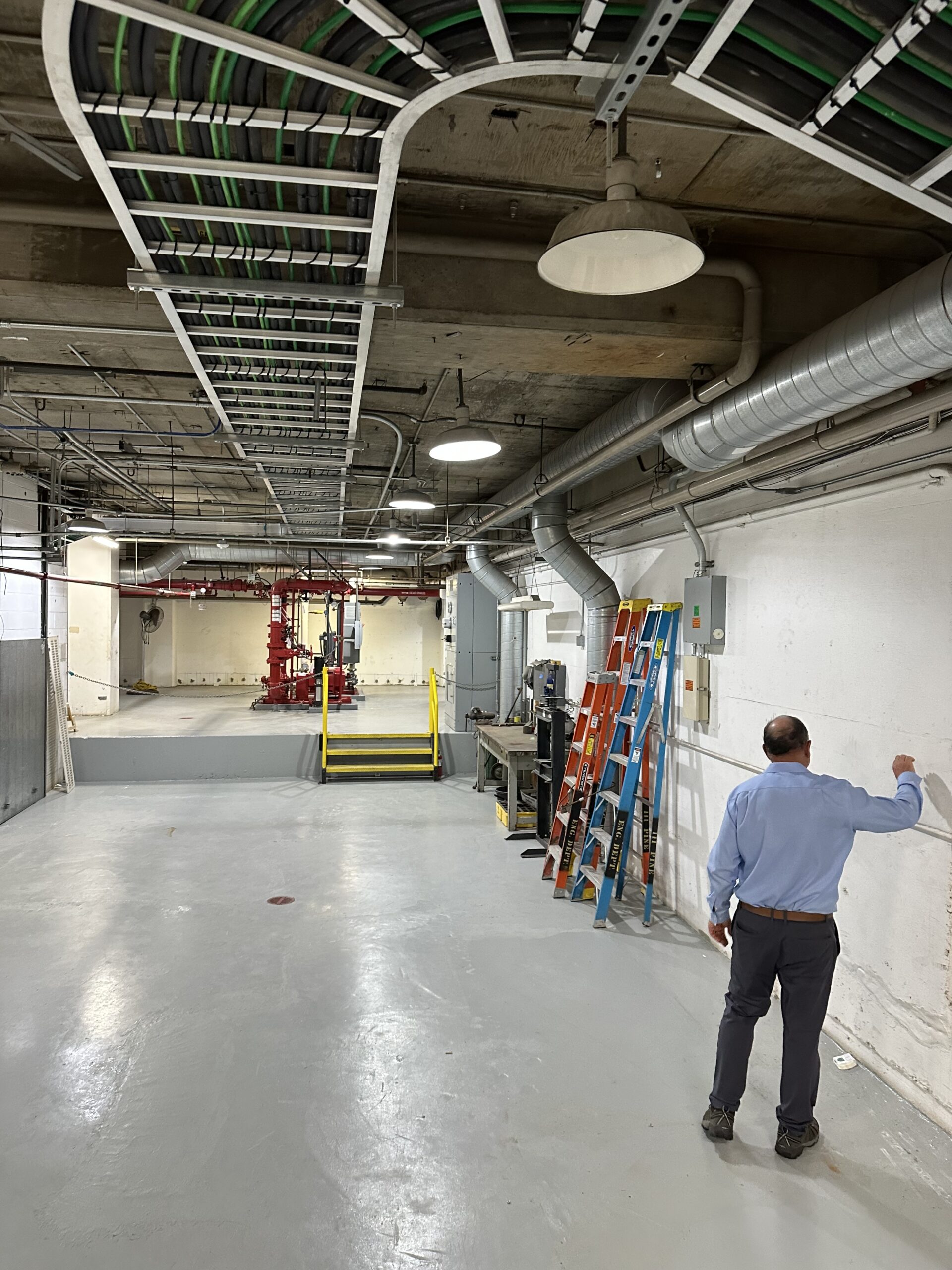
ZFA is providing structural engineering services for the seismic retrofit of a mid-rise 250,000-square-foot building built in 1963. The scope of work addresses deficiencies that will satisfy SFEBC Appendix A Chapter A6, which provide criteria intended to exempt the building from any local mandatory seismic retrofit requirements for the next 20 years.
The building is a typical cast-in-place mid-rise building with a 7¾-inch-thick floor slab spanning to interior concrete columns and walls. The perimeter of the building is constructed with concrete beams spanning to perimeter columns, and the whole structure is clad with precast concrete panels.
The approach to the seismic retrofit is to utilize viscous and hysteretic dampers throughout the building to decrease story drifts and reduce the building’s overall torsional response, keeping seismic demands in existing elements below their capacity. The viscous dampers would offset additional forces due to the increase in stiffness provided by the hysteretic dampers. These viscous dampers (similar to shocks in a vehicle or mountain bike – but much larger), are dependent on velocity, hence do not add forces to the existing structure. Rather, they absorb/dissipate earthquake energy without distress to the existing structure. Damper locations at all levels will consider impacts to existing architectural and MEP systems to minimize cost.
In addition to dampers, some beams, columns, and beam-to-column joints will be strengthened using FRP and/or steel jackets. New concrete shear walls will be added at select locations in the basement and ground floor levels to mitigate a discontinuous shear wall condition at these floors. New micropile foundations will be used to augment the existing foundations to support new elements as required.
University of San Francisco – Masonic East Seismic Retrofit
SAN FRANCISCO, CA
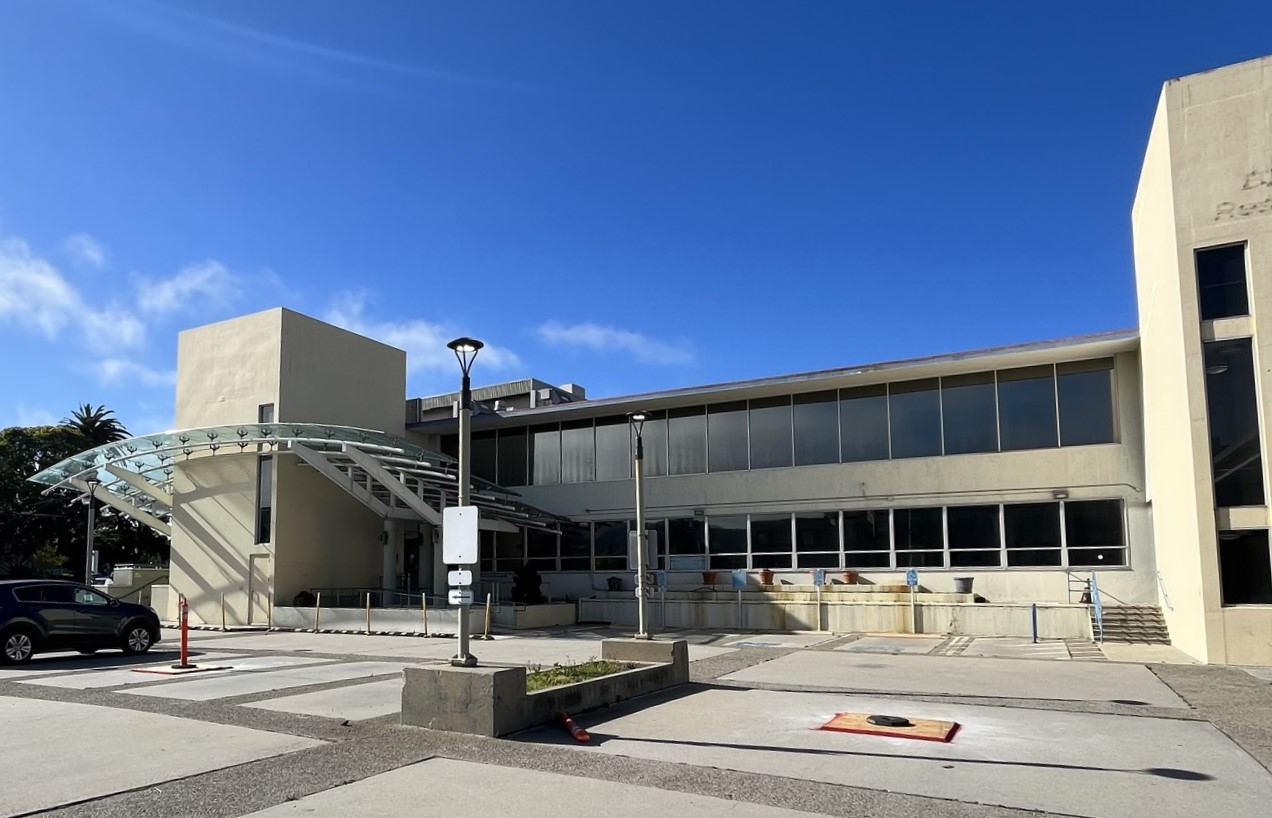
The seismic retrofit of this 1954 cast-in-place non-ductile concrete building began with a condition assessment of the 75,000-square-foot building that comprises a roughly equally-sized basement, ground floor, and second floor level. The retrofit was designed to improve occupant safety and is intended to meet the performance objectives to exempt it from any forthcoming mandatory retrofit ordinances.
The existing concrete shear walls and collector elements were found to be inadequate. ZFA designed new interior concrete shear walls, strengthened existing shear walls, and designed new collectors in multiple locations. Additionally, existing beams and columns supporting discontinuous shear walls above were strengthened. Since the existing columns were found to have inadequate ductility, FRP jackets were designed to allow the columns to displace to the required horizontal drift while maintaining their vertical load carrying capacity.
Broadway Street Seismic Retrofit
OAKLAND, CA
ZFA performed a seismic evaluation and designed a subsequent seismic retrofit of a 1960s-era, 12-story concrete moment frame building in Oakland. The evaluation and retrofit were in accordance with ASCE 41-17 for three discrete levels of seismic performance as selected by the client. ZFA selected 11 ground motions from the NGA-WEST2 database and spectrally matched them to the target seismic hazard of the BSE-2E for use in Nonlinear Response History Analysis. The first retrofit design employed a targeted combination of fluid viscous dampers and exterior column strengthening to achieve the desired performance.
Subsequent to this effort, ZFA provided two reduced-scale retrofit concepts and performed incremental dynamic analysis, reducing the scale factors on time histories (earthquake records) little by little until the retrofit approach met the acceptance criteria. Following this, in an effort to convey the level of seismic protection to the client, ZFA translated this level of shaking back into a Moment Magnitude of earthquake using the NGA-WEST2 ground motion prediction equations. ZFA then coordinated a cost estimate of all three retrofit concepts with a general contractor to develop ROM pricing, which enabled visualization of benefit in terms of dollars of retrofit per level of earthquake.

King Estates Middle School Seismic Retrofit
OAKLAND, CA
The King Estates Middle School project consisted of a seismic retrofit of three non-ductile concrete buildings. The buildings are low-rise concrete structures supported on concrete drilled pier foundations with concrete walls and precast double tee roofs. The buildings were evaluated to the requirements established in DSA Procedure 08-03 and ASCE 41-06. The retrofit scheme included FRP roof diaphragm strengthening, wall-to-diaphragm connection strengthening, wall-to-foundation connections, and new reinforced concrete grade beams. The project was completed over a single summer break and finished in time for the new school year without any closures.

Sylvia Mendez Elementary School Seismic Retrofit
BERKELEY, CA
ZFA is providing structural engineering services for the renovation, revitalization, and expansion of the Sylvia Mendez Elementary School campus. The 50,000-square-foot, one- and two-story non-ductile concrete facility was built in 1949 and constructed largely of reinforced concrete walls, floors, and roofs.
Renovations to the donut-shaped building are extensive and include upgrades to all classrooms and support spaces. The structure of the building will be updated to meet 2019 building code requirements using ASCE 41-17, and the retrofit involves the addition of shotcrete shear walls, new and strengthened collector elements, and associated new foundations. Two new elevators and one new staircase are being added, and a new seismic joint will be installed to separate the one- and two-story portions of the building for improved seismic performance. The work is being completed over the course of one school year and multiple summers.